Watts in, warmth out, and the running cost between them · review
De'Longhi TRRS0920 review
A 2 000 W oil-filled radiator with 9 fins, sold under De'Longhi's Radia S line. De'Longhi states a safety thermostat for overheat cutoff, a stepless temperature-and-power dial, its own 'Real Energy' gradual-heat control, and 360° castors with front and rear handles for moving it between rooms. Coverage is stated as up to 60 m³ on the German listing.
The bottom line The heaviest, slowest-to-heat, and steadiest option of the four — a reasonable pick if you want warmth that lingers after the radiator switches off, rather than the fastest possible warm-up.
What “oil-filled” changes about how it heats
De’Longhi’s Radia S is built around 9 fins filled with heated oil, rather than a fan pushing air across a ceramic or metal element. The practical difference De’Longhi itself highlights is residual heat: the oil keeps radiating warmth for a while after the unit is switched off, which neither the Rowenta Compact Power nor the Dreo Atom 316 reviewed alongside it can do, since both stop producing heat the instant their element loses power. The trade-off, which De’Longhi doesn’t advertise but is inherent to the technology, is a slower initial warm-up — the oil itself has to heat before the fins get properly warm.
Power, control, and De’Longhi’s “Real Energy” claim
At 2 000 W, this is tied with the Rowenta Compact Power’s Turbo setting for the highest wattage in this four-heater comparison. Temperature and power are set with a single stepless dial rather than a digital thermostat with a numeric target — De’Longhi calls the underlying control logic “Real Energy” and describes it as gradually increasing heat toward the desired temperature to reach it faster and hold running costs down. We’re repeating that as De’Longhi’s own description of how the control system behaves, not as an independently verified efficiency figure.
Safety thermostat, not a tip-over sensor
De’Longhi’s listing states a safety thermostat for overheat protection — a real, named safety feature, distinct from the main control dial. What isn’t in the published spec sheet is any tip-over-specific sensor, of the kind Dreo names explicitly for the Atom 316. That’s not unusual for oil-filled radiators, which are heavy and low-slung by design and rely partly on that weight and base stability rather than an electronic tilt sensor, but we’d rather say plainly that De’Longhi doesn’t publish one than imply it has a feature it doesn’t state.
Size, weight, and moving it around
At 12.2 kg, this is by a wide margin the heaviest heater in this comparison — nearly nine times the Dreo Atom 316’s 1.38 kg. De’Longhi addresses that directly with 360° castors and front-and-rear handles, which matters more here than on a lighter heater, since this isn’t something you’ll want to lift by one hand. The stated dimensions (16 × 47.2 × 65 cm) put it closer to a piece of furniture than a portable appliance, which fits its likely use case: a room you heat for hours at a time rather than a spot you heat briefly and move on from.
Running cost, without guessing at electricity prices
At 2 000 W, one hour of continuous full-power use draws 2 kWh — the same per-hour draw as the Rowenta’s Turbo mode. Multiply that by your own electricity tariff for an actual cost figure; we’re deliberately not publishing a €-per-night estimate, since doing so would mean picking an electricity price out of the air rather than reporting something De’Longhi or Amazon actually states.
Where we found it in stock
We checked Amazon.com (US), Amazon.co.uk (GB), Amazon.de (DE), Amazon.fr (FR), Amazon.it (IT), and Amazon.es (ES). ASIN B00ZUUEBOQ carried a live offer on DE, FR, IT, and ES, with prices from about 118 € (IT) to about 147 € (DE). We found no live offer, and in the case of US no catalog entry at all, on either the US or GB Amazon site at the time we checked.
Prices quoted in this text were read on 2026-08-24. The live price is at the top of the page.
Where this one sits in its aisle
At 118 €, it is the 3 cheapest of the 4 models in this category published here.
Cheapest in the aisle33 €
Median118 €
Dearest in the aisle170 €
What we like, and what we don't
Strengths
Heaviest, most stable of the four heaters here (12.2 kg), which suits a fixed spot rather than frequent moving
De'Longhi explicitly names a safety thermostat for overheat cutoff, separate from the main temperature dial
Residual heat after shutoff is a real property of oil-filled radiators, and De'Longhi states it directly
De'Longhi is a widely recognised appliance brand with a broad international distribution footprint
Compromises
No digital display, no timer, and no remote mentioned anywhere in the published listing
No tip-over sensor is named — De'Longhi relies on the unit's own weight and base rather than a stated electronic sensor
Slowest of the four to reach a set temperature by design, since the oil itself has to heat up first
Stated coverage (60 m³) is specific to this exact ASIN; De'Longhi sells other Radia S sizes with different figures, so it's easy to compare the wrong variant
Specifications
Power
2 000 W
Heating type
Oil-filled radiator, 9 fins
Thermostat
Stepless dial for temperature and power; no numeric °C setpoint published. A separate safety thermostat handles overheat cutoff, per De'Longhi
Coverage
Up to 60 m³, per the German listing for this ASIN (De'Longhi sells other Radia S variants rated to different volumes — check the specific listing)
Mobility
360° castors, front and rear handles
Residual heat
De'Longhi states the oil keeps radiating heat for a while after the unit is switched off
Weight / size
12.2 kg · 16 × 47.2 × 65 cm
Amazon reference
B00ZUUEBOQ (live offer confirmed on DE/FR/IT/ES; not found with a live offer on US/GB at check time)
Questions people actually ask
Why would I choose an oil-filled radiator over a fan heater?
We're reporting De'Longhi's own stated property rather than a general claim: the oil inside keeps radiating heat for a while after the unit is switched off, which the two fan heaters in this family (Rowenta Compact Power, Dreo Atom 316) don't offer, since they stop producing heat the moment the element powers down.
Does it have a tip-over safety switch?
Not published for this model. De'Longhi names a safety thermostat for overheat protection, but no tip-over-specific sensor is mentioned in the listing we checked.
What does '60 m³' coverage actually mean here?
It's the figure stated on the German listing for this exact ASIN, expressed in cubic metres rather than square metres — so it already accounts for ceiling height, unlike a flat m² figure. De'Longhi sells other radiators in the same Radia S line rated for different volumes, so this number applies to the 9-fin, 2 000 W version reviewed here specifically, not to the whole product family.
Our score
7.5/ 10
The heaviest, slowest-to-heat, and steadiest option of the four — a reasonable pick if you want warmth that lingers after the radiator switches off, rather than the fastest possible warm-up.
Who this one is for
A room you want to heat steadily over hours rather than minutes, where the weight and slower warm-up of an oil-filled radiator are an acceptable trade for residual heat after it's switched off.
Compared with its closest rivals
Same category, nearest prices. Only the specifications every one of them states are shown — a half-empty column compares nothing.
Model
Price
Power
Thermostat
Weight / size
Amazon reference
De'Longhi TRRS0920
118 €
2 000 W
Stepless dial for temperature and power; no numeric °C setpoint published. A separate safety thermostat handles overheat cutoff, per De'Longhi
12.2 kg · 16 × 47.2 × 65 cm
B00ZUUEBOQ (live offer confirmed on DE/FR/IT/ES; not found with a live offer on US/GB at check time)
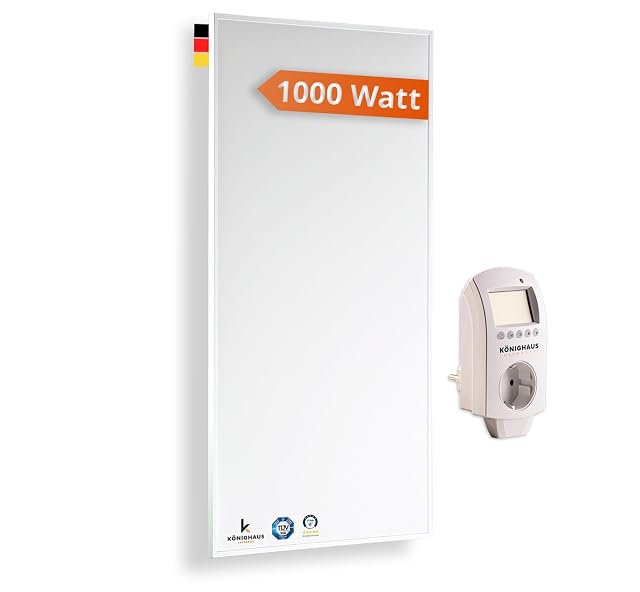
1 000 W (this listing; Könighaus's P-Serie also comes in 130/300/450/600/800/1200 W)
Not confirmed included — Könighaus's delivery-contents list names only mounting hardware and a 1.8 m cable, and its own copy recommends pairing the panel with a thermostat, which reads as a separate accessory rather than an included part
8.5 kg · roughly 100 × 60 × 1.8 cm
B0CTFJDX6R (live offer confirmed on DE/FR/IT/ES; listed but with no live offer on US, not found on GB)
1 500 W PTC ceramic · 5–35 °C in ±1 °C steps · tip-over sensor
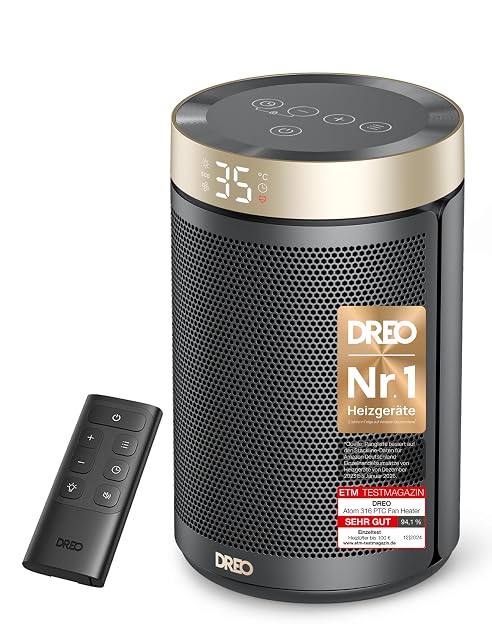
A 1 500 W PTC ceramic heater — Dreo's 'Hyperamics' system — with a thermostat adjustable from 5 to 35 °C in 1 °C steps, a tilt-detection tip-over sensor, overheat protection, and V0 flame-retardant housing. Dreo states 34 dB of operating noise from its brushless DC motor, and units sold since 5 September 2025 include a remote control.
Best for: A bedroom or home office where quiet running and a specific thermostat setpoint matter more than outright wattage.
1 000 W infrared panel · wall-mount · aluminium frame
A wall-mounted 1 000 W infrared radiant panel from Könighaus's P-Serie line, built into a powder-coated aluminium frame. Könighaus states no fan and no forced air circulation, publishes a wattage-to-room-size table across its whole line (130 W to 1 200 W), and backs the panel with a 5-year manufacturer warranty. The box includes mounting hardware and a 1.8 m cable — Könighaus's own listing does not confirm a thermostat is included.
Best for: A well-insulated room where silent, fan-free radiant heat is worth paying more for than a fan heater's faster warm-up.
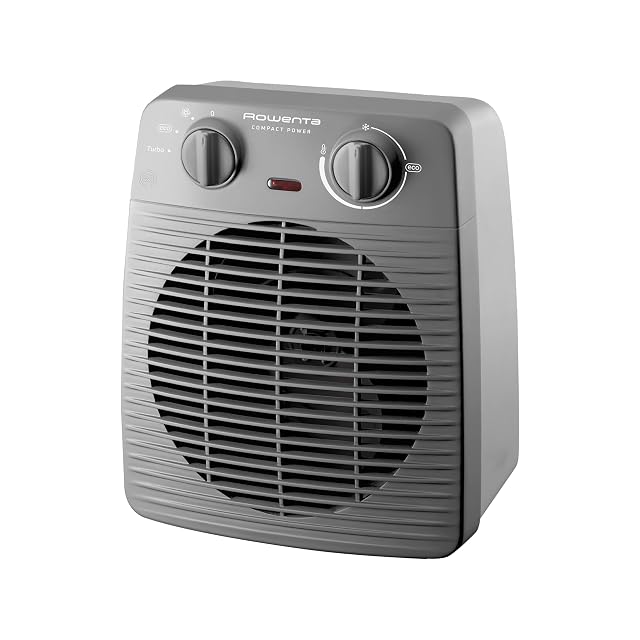
A compact electric fan heater with two heat stages — 1 000 W ECO and 2 000 W Turbo — plus a fan-only cool-blow setting. Rowenta publishes a mechanical thermostat, an automatic overheat shutoff with an integrated thermal fuse, and a 15-year repairability commitment backed by a network of 6,200 repair centres.
Best for: A small room, bathroom, or desk where the priority is low upfront cost rather than precise temperature control.