Millilitres an hour, and what they leave on the furniture · review
Philips HU2716/10 review
Philips' Series 2000 evaporative humidifier uses NanoCloud technology — a wick-based natural-evaporation process rather than an ultrasonic disc — rated at 200 ml/h from a 2 L tank, covering up to 32 m², at a stated 33 dB. Philips publishes 3 humidity levels plus a sensor-driven auto mode and a sleep mode, and states the evaporative process does not disperse the mineral dust associated with ultrasonic humidifiers.
The bottom line The only evaporative model in this comparison, and the one to pick specifically to sidestep the white-dust issue that comes with ultrasonic mist in hard-water areas. It costs more and holds less water than the ultrasonic alternatives here, which is the trade-off for the different technology rather than a flaw.
Evaporative technology, not ultrasonic
The HU2716/10 works differently from the other three humidifiers in this comparison. Instead of an ultrasonic disc vibrating water into a fine mist, Philips’ NanoCloud system draws air through a moistened wick and releases the resulting water vapor into the room — the same basic principle as natural evaporation, just fan-assisted. Philips states this process does not carry dissolved minerals into the air, which is the underlying reason evaporative humidifiers are generally not associated with the fine white dust that ultrasonic models can leave on hard water. We report this as Philips’ own explanation of the technology rather than an independent lab comparison.
Output, tank, and coverage
Philips rates moisture output at up to 200 ml/h and coverage at up to 32 m², the largest room rating among the four humidifiers we compared. The tradeoff is tank size: at 2 L, it’s the smallest tank here, giving a stated continuous runtime of up to 15 hours — shorter than the larger-tank ultrasonic models in this line-up, meaning more frequent refills for continuous use.
Modes and the sensor-driven auto setting
Control runs through 3 fixed humidity/speed levels, a sleep mode, a timer, and an auto mode that Philips describes as governed by a smart humidity sensor — the unit adjusts its own output based on measured conditions rather than requiring the level to be set and left. That’s a step up from a purely manual dial, though the listing does not show a numeric humidity-percentage display anywhere on the unit itself, so there’s no on-device readout of exactly what the sensor is measuring.
Noise and upkeep
Philips publishes 33 dB for operating noise — audible but not loud, and higher than the ultrasonic humidifiers in this comparison, which is typical for a design that moves air through a wick with a small fan rather than staying silent like a purely ultrasonic disc. The wick itself is a wearing part in evaporative humidifiers generally; Philips’ listing doesn’t specify a replacement interval for this particular model, so we’re not inventing one.
Where we found it in stock
We checked Amazon.de, Amazon.fr, Amazon.it, Amazon.es, Amazon.com, and Amazon.co.uk. ASIN B08LW4K16N carried a live offer on DE, FR, IT, ES, and GB, with prices from about 90 € (DE/IT) to about 106 € (ES) in the euro markets, and roughly £125 on Amazon.co.uk. We found no live offer on Amazon.com at the time we checked.
Bottom line
This is the model to pick in this comparison specifically for its evaporative technology: no ultrasonic mineral dust, a genuinely wide 32 m² coverage rating, and sensor-driven auto mode. It costs the most of the four and holds the least water, so it suits a household that values the technology difference more than tank capacity or price.
Prices quoted in this text were read on 2026-08-24. The live price is at the top of the page.
Where this one sits in its aisle
At 90 €, it is the 4 cheapest of the 4 models in this category published here.
Cheapest in the aisle30 €
Median80 €
Dearest in the aisle90 €
What we like, and what we don't
Strengths
Evaporative NanoCloud technology avoids the white mineral dust that ultrasonic humidifiers can leave with hard tap water — a real technical difference Philips documents, not just a marketing label
Sensor-driven auto mode adjusts humidity level automatically rather than requiring a manual dial setting
33 dB is a published, specific noise figure rather than a vague 'quiet operation' claim
3 fixed humidity/speed levels plus auto and sleep modes give more granular control than the entry-level model in this comparison
Compromises
The most expensive of the four humidifiers in this comparison, at roughly double the price of the entry-level Levoit
2 L tank is the smallest by capacity here despite the highest price, giving a shorter 15-hour runtime than the larger-tank models
No numeric humidity-percentage display or app control — the auto mode is sensor-driven but not shown as a readable target figure
No live Amazon offer found on Amazon.com at the time we checked
Specifications
Technology
Evaporative, NanoCloud wick — not ultrasonic
Mist/moisture output
Up to 200 ml/h, per Philips
Tank
2 L, removable
Coverage
Up to 32 m², per Philips
Runtime
Up to 15 hours continuous use on one fill, per Philips
Noise
33 dB, per Philips
Modes
3 humidity/speed levels, sensor-driven auto mode, sleep mode, timer
Mineral dust
Philips states the NanoCloud process does not disperse mineral dust or leave wet spots, unlike ultrasonic humidifiers
Amazon reference
B08LW4K16N (live offer confirmed on DE, FR, IT, ES, GB; no live offer found on US)
Questions people actually ask
What is NanoCloud technology, and how is it different from ultrasonic?
NanoCloud is Philips' name for an evaporative process: air is drawn through a moistened wick and the resulting water vapor is released, rather than a vibrating disc breaking water into a fine mist. Philips states this method does not carry dissolved minerals into the air the way ultrasonic mist can, which is why evaporative humidifiers are generally associated with less white dust on hard water.
How loud is it, and does it have a sleep mode?
Philips rates operating noise at 33 dB and includes a dedicated sleep mode alongside 3 manual humidity/speed levels and a sensor-driven auto mode.
Does it show the exact humidity percentage in the room?
Philips describes a smart humidity sensor that drives the auto mode, but the listing does not show a numeric humidity readout on the unit. If a visible percentage display matters, the Levoit Classic 300S in this same comparison publishes an LED display.
Our score
7.5/ 10
The only evaporative model in this comparison, and the one to pick specifically to sidestep the white-dust issue that comes with ultrasonic mist in hard-water areas. It costs more and holds less water than the ultrasonic alternatives here, which is the trade-off for the different technology rather than a flaw.
Who this one is for
A household in a hard-water area, or anyone who wants to avoid ultrasonic mineral dust specifically, and is willing to pay more and refill more often for that.
Compared with its closest rivals
Same category, nearest prices. Only the specifications every one of them states are shown — a half-empty column compares nothing.
Model
Price
Technology
Tank
Coverage
Runtime
Philips HU2716/10
90 €
Evaporative, NanoCloud wick — not ultrasonic
2 L, removable
Up to 32 m², per Philips
Up to 15 hours continuous use on one fill, per Philips
Up to 25 hours on the lowest mist setting, per Levoit
What separates these models
If price decides: Levoit Classic 160, at 30 €.
Highest Tank in the table: Levoit Classic 300S (6 L, top-fill).
Highest Coverage in the table: Levoit Classic 300S (Up to 47 m², per Levoit).
If this one is not the right fit
On a tighter budget: Levoit Classic 160, at 30 € in the same category. see the review
If you need more Tank: Levoit Classic 300S states 6 L, top-fill. see the review
Guides that feature it
The Best Humidifier 2026 | AirVerdict
Price and availability
A reference exists on these Amazon stores: France, Germany, Italy, Spain, United Kingdom. Listed is not the same as in stock — availability changes daily.
Details checked on August 24, 2026.
Sources
Specifications: manufacturer sheet and Amazon product page. Prices and availability: Keepa. No product on this site has been physically tested.
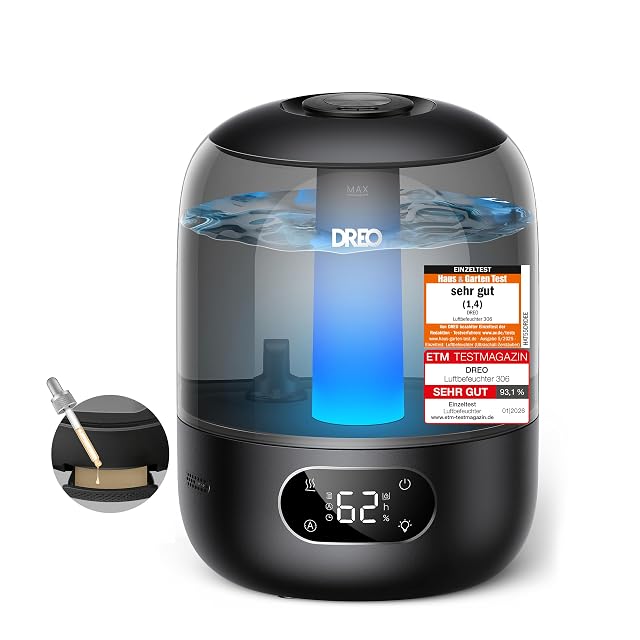
250 ml/h ultrasonic cool mist · 3 L top-fill tank · 26 dB sleep mode
Dreo rates this ultrasonic cool-mist humidifier at 250 ml/h from a 3 L top-fill tank, with a 360° nozzle reaching up to 40 inches, a stated 26 dB in sleep mode, up to 30 hours of runtime, adjustable ambient light, and a separate aroma-pad tray for essential oils. Dreo's listing also names a built-in humidity sensor, though it does not describe a numeric auto-target mode tied to that sensor.
Best for: A bedroom or nursery where a quiet overnight runtime and a large refillable tank matter more than app control or a numeric humidity display.
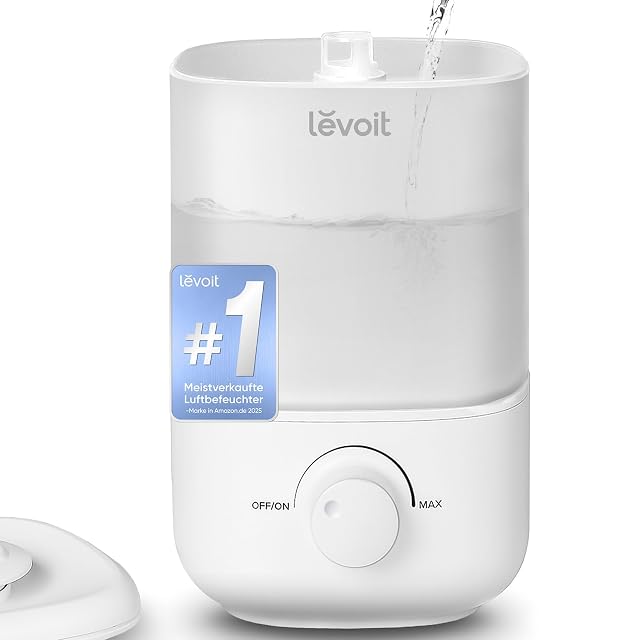
2.5 L tank · 23 dB · up to 25 h runtime, lowest setting
Levoit's entry-level ultrasonic humidifier, rated at 23 dB with a 2.5 L top-fill tank covering up to 20 m² and up to 25 hours of runtime on the lowest mist setting. Mist volume is controlled with a manual dial and a 360° nozzle; there is no humidity sensor, digital display, or auto mode published for this model.
Best for: A small bedroom or a second humidifier for a child's room, where a low purchase price and simple manual control matter more than smart features.
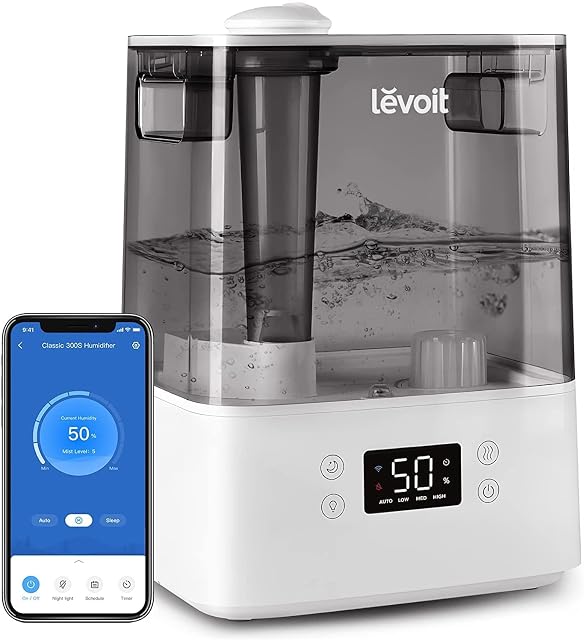
6 L tank · humidity-sensor auto mode with LED display · 26 dB sleep mode
Levoit's top model in this comparison: a 6 L ultrasonic top-fill humidifier with a built-in humidity sensor that drives an automatic mode, a touch-operated LED display, app control through VeSync, and Alexa/Google Assistant voice control. Levoit states up to 60 hours of runtime, coverage up to 47 m², and 26 dB in sleep mode with the display dimmable.
Best for: A larger bedroom or shared space where app/voice control, a long refill interval, and sensor-driven auto humidity matter more than the lowest possible price.