A permanent fixture, not a machine you put away in autumn · review
Vtronix Classic America TWC-08CRD1-L0U-CA review
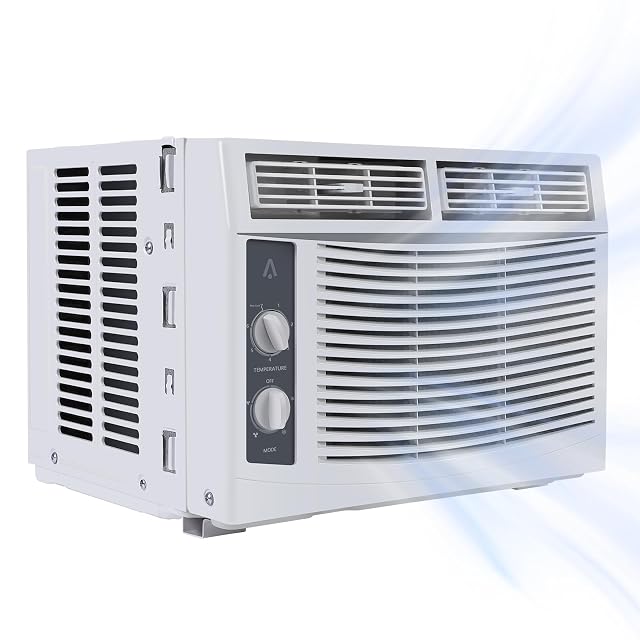
An 8,000 BTU/h window unit with WiFi and Alexa control alongside the physical remote, an eco mode, and a programmable timer, rated for rooms up to about 32 m². Energy Star-listed at 10.9 CEER. Like every window air conditioner we checked in this family, it is built to a North American 120 VAC electrical spec, not the 230 V mains used across the EU and UK.
The bottom line Of the two window units we checked for this family, this is the more capable one on paper — more cooling capacity, an eco mode, and WiFi and Alexa control that the cheaper mechanical pick doesn't offer — and it was also the only one of the two genuinely in stock across all six markets we tested, rather than intermittently available. That said, the fundamentals of this category in Europe haven't changed: it's a North American 120 VAC product, cool-only despite the smart features, and our Keepa check found it priced at roughly two and a half times its US list price once it reaches European third-party sellers. Window air conditioners remain a smaller, US-shaped category here than they are in North America, and this unit is a capable example of the format rather than a case against that pattern.
What the smart features add
This is the more equipped of the two window units we checked in this family. Alongside the physical remote, the manufacturer lists control through a companion app and Alexa, an eco mode aimed at cutting standby draw, a programmable timer, and a “low power start” feature intended to soften the initial compressor surge. At 8,000 BTU/h it is also rated for a noticeably larger room than the entry-level mechanical pick in this same family — up to about 32 m² against roughly 14 m².
Still a North American product
The electrical spec is unchanged from the rest of this category: 120 VAC, stated identically across every market’s listing, including the German, French, Italian, and Spanish pages. There is no 230 V version of this ASIN. The efficiency figure quoted — 10.9 CEER — is a US Department of Energy metric used for Energy Star qualification, and it isn’t the same scale as the SEER rating used on EU energy labels, so it’s worth treating as a US reference number rather than something directly comparable to a European-market unit. Anyone importing this into the EU or UK needs a step-down transformer sized for the compressor’s real load, not just a plug adapter.
Availability across markets
This was the more reliably available of the two ASINs in our check. Where the entry-level mechanical pick showed patchy stock on some markets, this unit had a New third-party offer in stock over the trailing 30 days on all six markets we tested — Germany, France, Italy, Spain, the US, and the UK. That consistency is worth something in a category where, per our research, a live Amazon catalogue page frequently turns out to carry no actual offer at all.
The price gap
Our Keepa price check put this unit at roughly 780 € on the cheapest European market we tested, against a US list price around 290 €. That’s a markup of roughly two and a half to two and three-quarter times, larger than what we found on the cheaper mechanical unit in this same family. It’s a direct illustration of what happens when a North American product category gets reshipped into a market that doesn’t stock it locally: not just a higher price, but a price set by import economics rather than by what the unit would cost if it were actually made for this market.
What’s missing
Two gaps are worth naming plainly. First, this is a cool-only unit — no heating mode, despite the WiFi and Alexa control. Second, nothing in the feature list mentions a digital thermostat display, which is a small step behind other WiFi-connected units at a comparable price point. Neither is a defect, but both are worth knowing before paying the European markup this unit currently carries.
Bottom line
If a reader specifically wants app or voice control on a window unit, and is prepared to handle the voltage conversion and pay a real European import premium, this is the more capable and more reliably available of the two units we checked in this family. It doesn’t change the underlying picture for the category here — North American voltage, North American pricing before markup, and a format that most European windows weren’t designed to take — but within those limits, it’s a genuine, well-documented product rather than a thin listing.
Prices quoted in this text were read on 2026-08-24. The live price is at the top of the page.
What we like, and what we don't
Strengths
WiFi and Alexa control in addition to the physical remote, which the entry-level pick in this family does not offer
Eco mode and a low-power start feature are both specifically called out as ways to cut running cost
The only one of the two ASINs we checked in this family with a New offer in stock, over the trailing 30 days, on all six markets — not just a live catalogue page
A stated 1-year manufacturer warranty appears on every market's listing, not just one
Compromises
120 VAC, the North American mains standard — the same voltage mismatch as every other unit in this niche, see the FAQ before ordering into the EU
Cool-only: no heating mode despite the smart feature set
No digital thermostat display mentioned anywhere in the feature list, which is a step behind some WiFi units at this price
European list prices we found ran at roughly 2.5–2.7× the US price for the identical ASIN — a heavy markup even by this category's standard
Specifications
Cooling capacity
8 000 BTU/h, rated for rooms up to 350 sq. ft. (about 32 m²)
Controls
Smart app + Alexa voice control, plus a physical remote
35.6 × 40.6 × 48.3 cm (H×L×W), about 20.4 kg; boxed 23.1 kg
Warranty
1 year, per manufacturer
Amazon reference
B093KHS91C (same ASIN on all 6 markets checked)
Questions people actually ask
Can this unit run on European 230 V mains?
Not without a suitable step-down transformer. The listing specifies 120 VAC across every market we checked, including the German, French, Italian, and Spanish pages — none of them offer a 230 V version of this ASIN. As with any North American-spec appliance, running it on EU or UK mains requires converting the supply correctly for the unit's full compressor load; check with the seller before ordering rather than assuming a plug adapter is enough.
What does the 10.9 CEER rating actually mean?
CEER (Combined Energy Efficiency Ratio) is a US Department of Energy metric — cooling output in BTU/h divided by power input in watts, including standby draw. It is the number used for Energy Star qualification in North America and is not directly comparable to the EU's SEER-based energy label, so treat it as a US-market reference point rather than a figure you can cross-check against European efficiency ratings.
Does the smart app work outside the US?
We could not verify this from the product listing or Keepa data — the feature description simply says the unit can be controlled from the manufacturer's Smart app or Alexa, without stating regional app-store or account restrictions. Anyone relying on the WiFi control specifically should confirm app availability in their country before buying, rather than assuming it from the marketing copy alone.
Our score
8.4/ 10
Of the two window units we checked for this family, this is the more capable one on paper — more cooling capacity, an eco mode, and WiFi and Alexa control that the cheaper mechanical pick doesn't offer — and it was also the only one of the two genuinely in stock across all six markets we tested, rather than intermittently available. That said, the fundamentals of this category in Europe haven't changed: it's a North American 120 VAC product, cool-only despite the smart features, and our Keepa check found it priced at roughly two and a half times its US list price once it reaches European third-party sellers. Window air conditioners remain a smaller, US-shaped category here than they are in North America, and this unit is a capable example of the format rather than a case against that pattern.
Who this one is for
A reader who specifically wants app or voice control on a window unit and is willing to pay a substantial European import markup for a North American product, and to handle the voltage conversion themselves.
If this one is not the right fit
On a tighter budget: MilleLoom 5 000 BTU, at 375 € in the same category. see the review
Guides that feature it
Window Air Conditioners 2026 — Which to Buy | AirVerdict
Price and availability
A reference exists on these Amazon stores: France, Germany, Italy, Spain, United Kingdom, United States. Listed is not the same as in stock — availability changes daily.
Details checked on August 24, 2026.
Sources
Specifications: manufacturer sheet and Amazon product page. Prices and availability: Keepa. No product on this site has been physically tested.
A basic mechanical window unit rated at 5,000 BTU/h for rooms up to about 14 m². Seven dial-set temperatures, three fan speeds, cool/dehumidify/fan modes, a 24-hour timer and auto-restart, with no app or WiFi. Built to a North American 115 V/60 Hz electrical spec, which matters more than the price tag for anyone ordering it into a European home.
Best for: A reader who wants the cheapest possible entry point into a window unit and is prepared to sort out a step-down transformer or import wiring themselves — not a plug-and-play pick for a European socket.
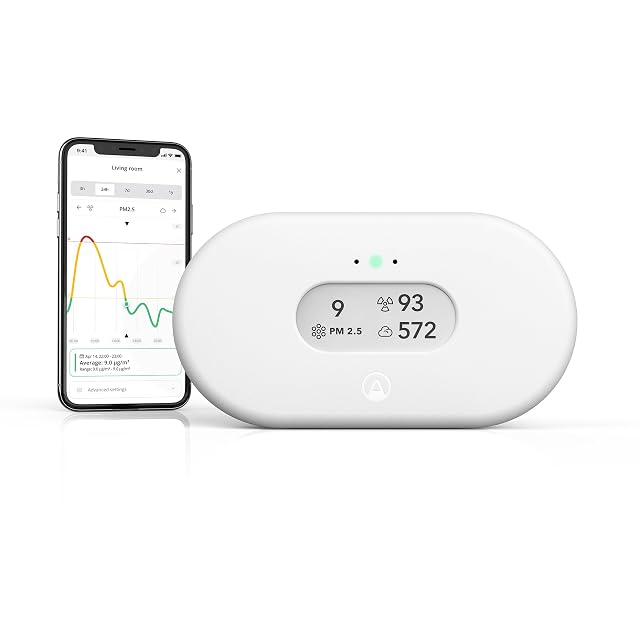
A seven-sensor Wi-Fi monitor covering radon, PM2.5, CO2, VOCs, humidity, temperature and air pressure, read through the Airthings app. Radon is sampled with a passive diffusion chamber and alpha-spectrometry detection; the unit runs on AA batteries or USB and can act as a hub for other Airthings devices.
Best for: Whole-home air monitoring where someone wants radon and VOC coverage alongside CO2 and particulates, and is comfortable running everything through the Airthings app.
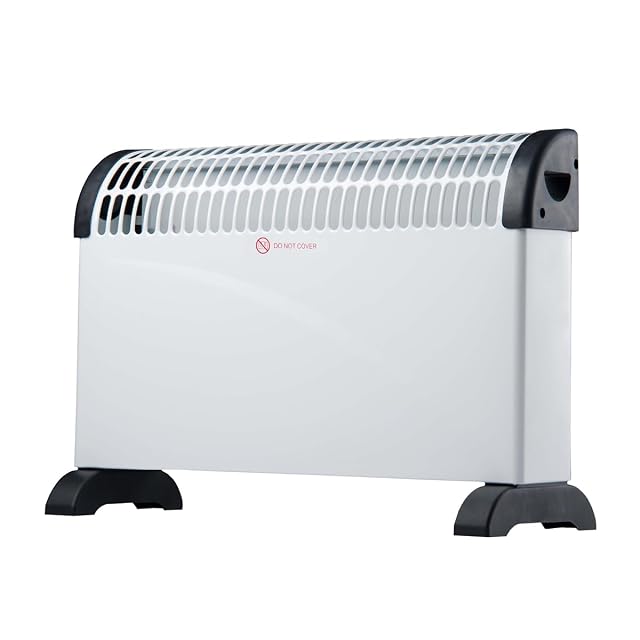
2 000 W · 3 heat settings · natural convection, no fan
A basic 2 000 W electric convector with three heat settings — 750 W, 1 250 W, and a 2 000 W 'Turbo' stage — controlled by an adjustable thermostat dial. Alpina describes pure natural convection with no fan, rates it for rooms up to 15 m², and states overheat protection. It's the cheapest heater in this family, but one of the four markets we checked shows a data problem worth knowing about before you buy.
Best for: The cheapest way into this family — a small room, workshop, or occasional-use space where basic convection heat at low upfront cost matters more than programming or thermal inertia.