Skip to content

Checking window compatibility before buying a portable AC

A portable air conditioner that doesn't fit the window it's meant for loses much of its rated cooling capacity to the gap around an improvised install.

Measure the actual opening, not the room

Width, height, and the opening mechanism all matter. Dreo’s AC318S kit, for instance, covers a 43–135 cm (16.9 to 53.1 in) width range across casement/tilt-turn and sliding windows — a wider stated range than some rivals — but every kit has limits worth checking against your specific window.

Window format varies more across Europe than the listings assume

Many portable AC kits are designed first around a North American-style sliding sash window. A tilt-and-turn or side-hinged casement window — the norm across much of continental Europe — often needs a different seal, sold separately or not at all for a given model.

Check for a wall-sleeve alternative

If no window kit fits the space, some manufacturers offer or support a wall-sleeve alternative, particularly for larger units like the Gymax KU65297IJ’s format. This is worth investigating before ruling a unit out entirely, or before assuming a window-only kit is the only route.

Don’t assume “universal” means your window

Kits marketed as fitting “most windows” still have a stated width range and an assumed opening style. Check the actual figures against your own measurements rather than trusting the word “universal” on its own — it’s a marketing claim, not a specification.

What we would not do

Order a portable AC based on BTU rating alone and plan to “figure out” the window afterward. A unit with excellent cooling capacity and a badly sealed installation performs worse in practice than a smaller unit properly fitted — installation quality is not a detail to sort out later.

The questions that keep coming up

What should I measure before ordering?

The window opening's width and height, and how it opens — sliding, tilt-and-turn, or casement. Compare those against the window kit's stated width range, which is usually published even when other installation details aren't.

What if my window doesn't slide?

Most included kits assume a sliding sash window. A tilt-and-turn or casement window, common across continental Europe, typically needs a different seal or a wall-sleeve alternative — check for one before assuming the box contents will fit as pictured.

Last reviewed 24 August 2026
What you need to have already

Everything above works with what you already own. These are the products we would reach for, and each links to the full review rather than straight to a shop.

  • Dreo DR-HAC008S

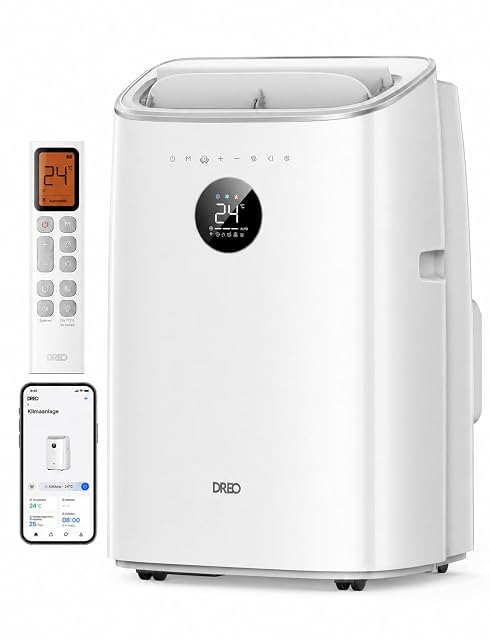
    7,500 BTU · drainage-free · 45 dB(A)

    A 7,500 BTU single-hose portable air conditioner Dreo positions for bedrooms and offices, built around what it calls a true drainage-free system: condensate is evaporated automatically via an internal pump and sensors, Dreo says, even up to 90% humidity. Operating noise is published at 45 dB(A) (61 dB sound power), with control through the Dreo app or Siri/Alexa/Google Home voice commands.

    Best for: Bedrooms or offices where quiet operation and hands-off condensate handling matter more than a low upfront price.

    8.0/10

    ≈ $23

  • Gymax KU65297IJ-BMDE

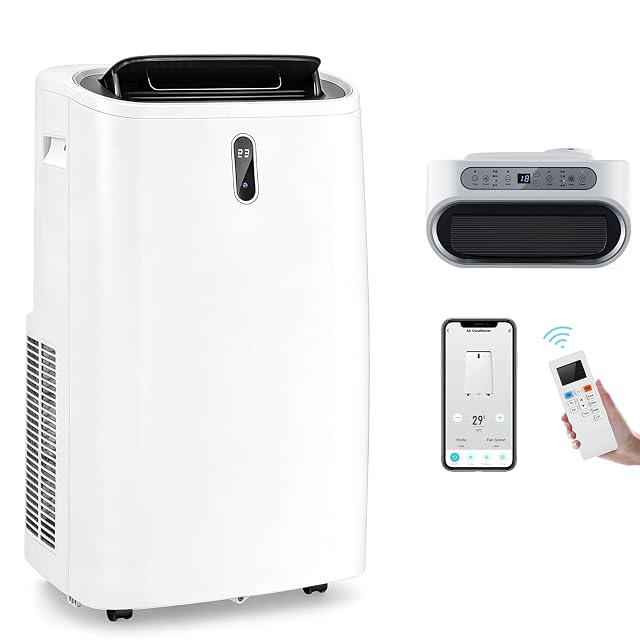
    16,000 BTU · 4-in-1 with heating · up to 45 m (148 ft)²

    A 16,000 BTU 4-in-1 portable air conditioner that adds a heating mode alongside cooling, dehumidifying and fan, for rooms Gymax rates up to 45 m (148 ft)². It's controlled by remote, on-unit panel, or WiFi through the 'Smart Life' app, and is the largest and most expensive of the four units in this comparison.

    Best for: Larger rooms up to 45 m (148 ft)² where one appliance needs to both cool in summer and add supplementary heat, bought from a market where it's confirmed in stock.

    8.4/10

  • MilleLoom 5,000 BTU

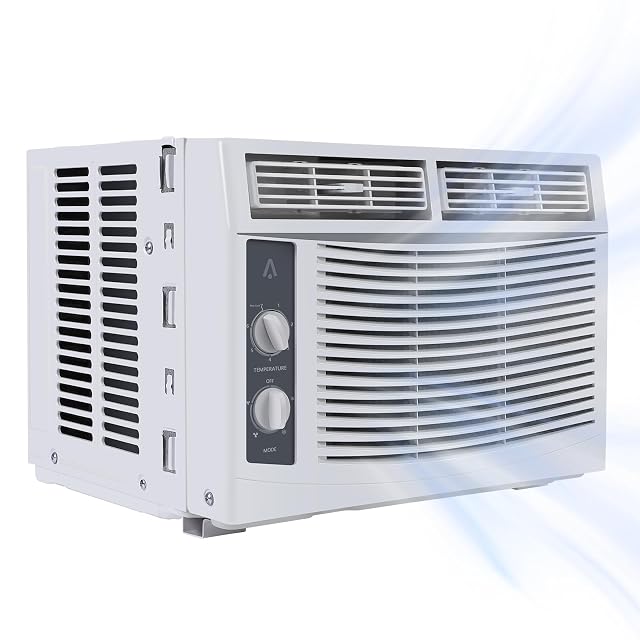
    5,000 BTU/h · mechanical dial · 115 V/60 Hz

    A basic mechanical window unit rated at 5,000 BTU/h for rooms up to about 14 m (46 ft)². Seven dial-set temperatures, three fan speeds, cool/dehumidify/fan modes, a 24-hour timer and auto-restart, with no app or WiFi. Built to a North American 115 V/60 Hz electrical spec, which matters more than the price tag for anyone ordering it into a European home.

    Best for: A reader who wants the cheapest possible entry point into a window unit and is prepared to sort out a step-down transformer or import wiring themselves — not a plug-and-play pick for a European socket.

    7.2/10

    ≈ $190