Skip to content

Reading manufacturer specs skeptically

The same handful of figures go missing again and again across brands and families, and knowing which ones to expect makes a genuine gap easier to spot.

Look for a reference condition, and expect it to be missing

A dehumidifier’s liters-per-day figure, a fan’s noise rating, an air conditioner’s BTU claim — nearly all of them are measured under conditions the manufacturer rarely states. Treat any such figure as an upper bound reached under favorable conditions, not a guarantee in your specific room.

Check whether a listing agrees with itself across markets

We’ve found real, documented cases in this family of a single product listed with different figures on different country marketplaces — the DREO DR-HPF002’s height range differs between its German and French listings, for instance. That’s a more concrete red flag than a missing spec, and worth checking directly on the current listing before ordering.

Read “Not published” as information, not an oversight

Where we mark a specification “Not published” on a review, that means the manufacturer’s own listing doesn’t state it — not that we didn’t look. Treat it the same way: a gap to factor into the decision, not a number to estimate on the brand’s behalf.

Weight-and-size data can come from the wrong source

Some listings mix a product’s actual dimensions with separate shipping-box logistics data, which can differ meaningfully — we’ve seen this directly on at least one heater in this family. Where a spec seems oddly light or small for the described product, it may be package data rather than the unit itself.

What we would not do

Assume a listing with more bullet points is more trustworthy than one with fewer. Marketing copy volume and genuine specification detail are different things — a short, precise listing with real numbers is worth more than a long one padded with adjectives.

The questions that keep coming up

What's the most commonly missing figure in this category?

A stated reference condition behind a headline number — the temperature and humidity a dehumidifier's liters-per-day figure was measured at, or the fan speed an air purifier's CADR and room-size claim assumes. Almost no manufacturer we've checked publishes it.

Should I distrust a listing that has gaps?

Not automatically — gaps are close to universal in this category, even among well-regarded brands. What's worth more scrutiny is a listing whose own figures contradict each other between markets, which is a different and more concrete problem.

Last reviewed 24 August 2026
What you need to have already

Everything above works with what you already own. These are the products we would reach for, and each links to the full review rather than straight to a shop.

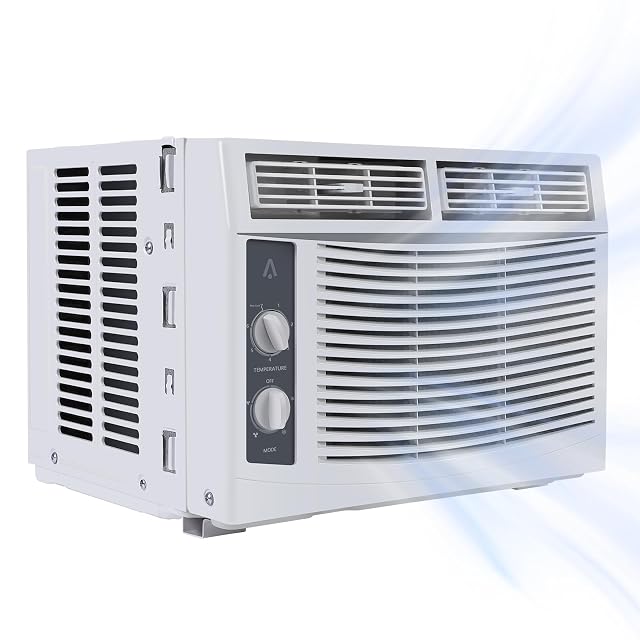
  • MilleLoom 5,000 BTU

    5,000 BTU/h · mechanical dial · 115 V/60 Hz

    A basic mechanical window unit rated at 5,000 BTU/h for rooms up to about 14 m (46 ft)². Seven dial-set temperatures, three fan speeds, cool/dehumidify/fan modes, a 24-hour timer and auto-restart, with no app or WiFi. Built to a North American 115 V/60 Hz electrical spec, which matters more than the price tag for anyone ordering it into a European home.

    Best for: A reader who wants the cheapest possible entry point into a window unit and is prepared to sort out a step-down transformer or import wiring themselves — not a plug-and-play pick for a European socket.

    7.2/10

    ≈ $190

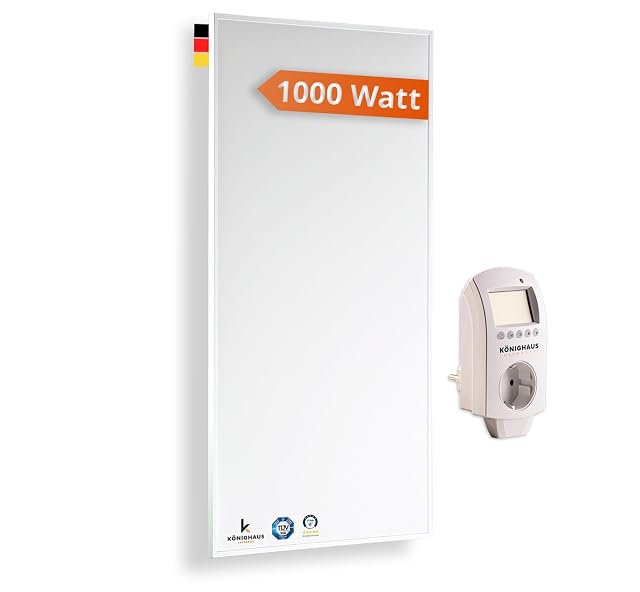
  • Könighaus P-Serie 1000 W

    1,000 W infrared panel · wall-mount · aluminum frame

    A wall-mounted 1,000 W infrared radiant panel from Könighaus's P-Serie line, built into a powder-coated aluminum frame. Könighaus states no fan and no forced air circulation, publishes a wattage-to-room-size table across its whole line (130 W to 1,200 W), and backs the panel with a 5-year manufacturer warranty. The box includes mounting hardware and a 1.8 m (6 ft) cable — Könighaus's own listing does not confirm a thermostat is included.

    Best for: A well-insulated room where silent, fan-free radiant heat is worth paying more for than a fan heater's faster warm-up.

    8.7/10

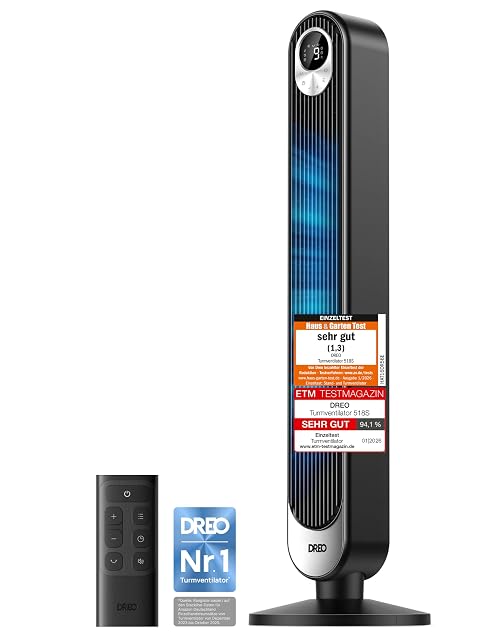
  • DREO Cruiser Pro T1

    DC motor · 106 cm (41.7 in) · 9 speeds, 4 modes · 90° oscillation, 12h timer

    A 106 cm (41.7 in) DC-motor tower fan with 9 speeds and 4 modes (Normal, Natural, Auto, Sleep), a 90° oscillation angle, and a 12-hour timer — the longest timer and finest speed control in this comparison. DREO states an 8.53 m (28 ft)/s air-discharge speed and an 11 m (36 ft) wind-throw distance, but publishes two different noise figures — 20 dB on one market, 28 dB on another — for the same ASIN.

    Best for: A bedroom or living room where fine speed control (9 steps) and the longest timer in this comparison matter more than height adjustment or a folding design.

    7.8/10

    ≈ $90