The rule of thumb, and its limits
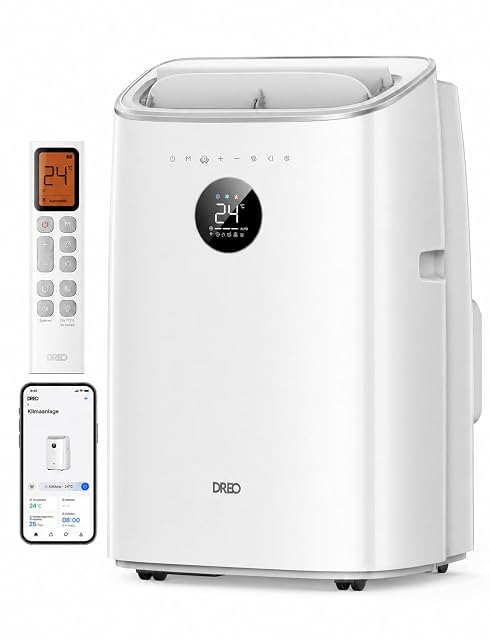
A commonly used starting point is roughly 100 W of cooling capacity per square meter of floor area in a well-insulated room with standard ceiling height. Dreo’s own guidance for the AC318S is close to this — about 210 W per m² by their figure, which sits on the more generous side. Neither figure accounts for your specific room.
What pushes the number up
A south- or west-facing room with large windows, a top-floor flat under an uninsulated roof, a kitchen with appliances running nearby, or a room that regularly holds more people than usual all demand more cooling capacity than the base rule suggests. Size up rather than down if two or more of these apply.
What a fixed m² figure hides
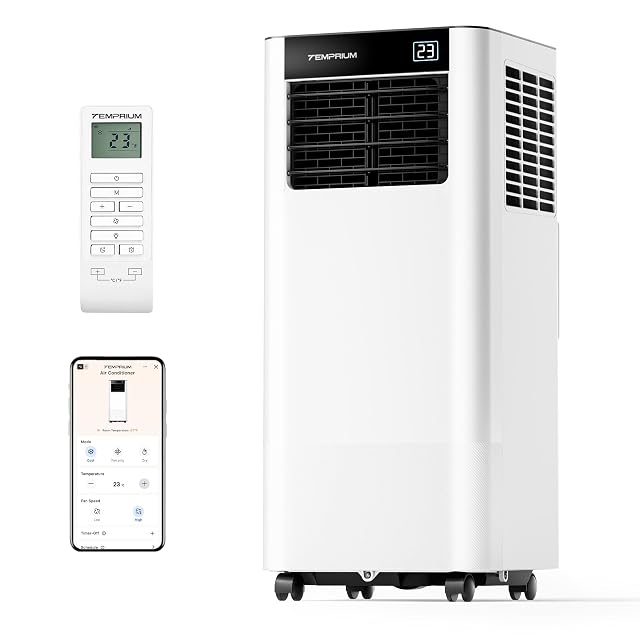
Temprium rates the YPK11S at up to 20 m (66 ft)², a fixed number with no stated ceiling height. A 20 m (66 ft)² room with a 3 m (10 ft) ceiling holds noticeably more air to cool than one with a 2.4 m (8 ft) ceiling — volume, not floor area, is what a compressor is actually working against, even though floor area is what gets printed on the box.
When to size up deliberately
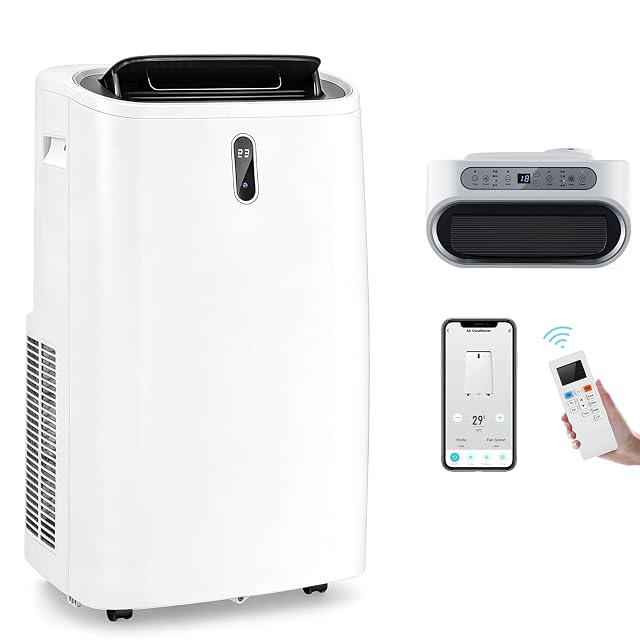
For a genuinely large or poorly insulated room, a higher-capacity unit like the Gymax KU65297IJ, rated up to 45 m (148 ft)², is the more honest starting point than trying to push a smaller unit past its comfortable range — an undersized compressor run constantly at maximum output is both less efficient and more likely to wear out early.
What we would not do
Trust a room-size rating with no stated reference condition as a precise figure. Every BTU rating in this family is the manufacturer’s own claim, measured under conditions they rarely publish — use it as a starting estimate, then adjust for your room’s actual sun exposure, insulation and ceiling height.
The questions that keep coming up
Is more BTU always safer than not enough?
Not entirely. An oversized unit cools the air quickly without running long enough to also remove much humidity, which can leave a room feeling clammy despite a lower temperature. Matching capacity to the room, not maximizing it, generally gives better comfort.
Do manufacturers publish the conditions their BTU rating assumes?
Rarely, and it's a real gap. Most portable AC listings we've checked in this family give a room-size figure with no stated reference temperature, ceiling height or insulation level behind it — treat the figure as an upper bound in favorable conditions.
Last reviewed 24 August 2026