Skip to content

The best indoor air quality monitor for 2026

The sensor behind the number is what actually matters here, and it's the specification these listings are least consistent about publishing. These pages report what each monitor measures and how the maker says it should be read — they do not turn a reading into a health verdict.

A plug-in traffic light, nothing to set up

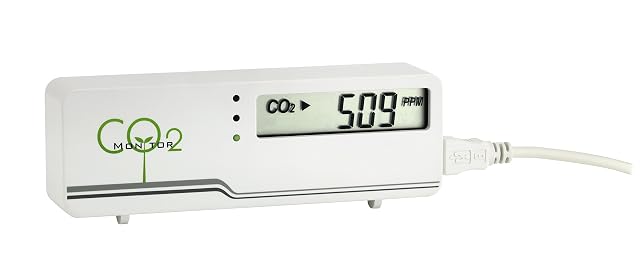
The TFA Dostmann AIRCO2NTROL Mini is first for a single room where a glanceable go/no-go cue is enough: a USB-powered display with a three-color LED and no app, no Bluetooth, and no battery to replace.

A named sensor, and Bluetooth logging

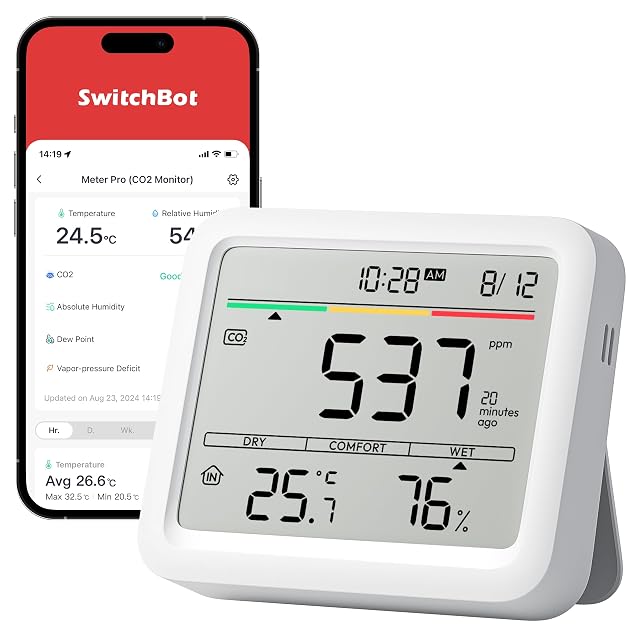
The SwitchBot Meter Pro CO2 steps up with a stated NDIR CO2 sensor and a published ±50 ppm accuracy figure, connecting via Bluetooth and an optional hub for remote access.

Seven sensors, and a whole-home approach

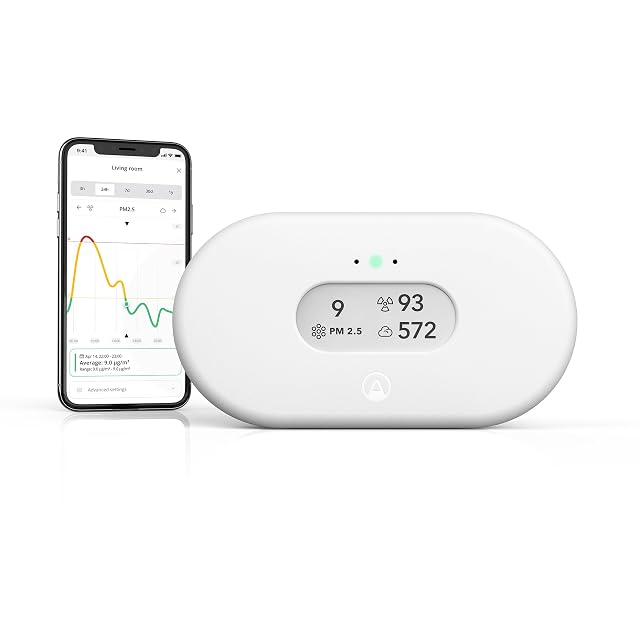
The Airthings View Plus is the pick for tracking more than CO2 — radon, PM2.5, VOCs, humidity, temperature and pressure, all through the Airthings app, which the manufacturer states is required for the device to function. It’s the most expensive of the three by a wide margin.

What we would not do

Buy any of these expecting a health diagnosis. A CO2 or particulate reading is a measurement, not a medical verdict — these monitors report a number, and what to do about it is a matter for ventilation practice and, where relevant, a qualified professional or your national health authority, not a comparison site.

Which unit does your room need?

You want to know when to open a window
A carbon dioxide sensor is enough and reads at a glance. It is the most actionable measurement of them all.
You suspect volatile compounds
A VOC sensor gives a trend, never an identification. It tells you something is happening, not what.
You are watching fine particles
An optical particle sensor, bearing in mind it counts particles and converts to mass, with the margin that implies.
You want a history
The app becomes the real subject: it holds the curves, and it can disappear with the maker.

Picking by the room you have

Bedroom and sleep

Carbon dioxide climbs quickly in a closed room with a sleeper. It is the measurement that changes a habit overnight.

Office and concentration

Same subject, different room: an exceeded threshold is fixed by opening a window for two minutes, and the reading tells you when.

After building work

VOCs off-gas for weeks. The sensor does not name them, but it shows the decline and says when forced ventilation can stop.

Kitchen and fireplace

Combustion produces particles and carbon monoxide. The second demands a certified detector, not a comfort monitor.

What is worth looking at, and what is not

The type of CO₂ sensor
A non-dispersive infrared sensor measures the gas; a so-called "equivalent CO₂" sensor estimates it from VOCs. The second costs less and sometimes talks nonsense when a solvent bottle is opened.
What the device actually measures
Many screens show five readings derived from two sensors. What to check is the number of physical sensors, not the number of figures displayed.
Calibration
A CO₂ sensor drifts. Most re-baseline automatically on the lowest value seen in a week, which assumes the room really is aired. In a room never aired, automatic calibration falsifies the reading.
Power and battery
A mains monitor stays put and measures continuously; a battery monitor travels and is forgotten flat in a drawer.

Matching the figure to the room

What you want to knowThe sensorIts limit
Should I open a window?Infrared CO₂It drifts and must re-baseline
Are there solvents about?VOCIt does not say which
Are there particles?OpticalAn estimate, not a weighing
Is there immediate danger?Certified CO detectorA comfort monitor is not a substitute

Where buyers go wrong

Treating a monitor as a safety device
A comfort monitor is not a certified carbon monoxide detector, and it will not wake anyone at night. They are two different devices, and the second is required in some homes.
Believing an overall quality index
The colored index blends unlike measurements by a formula the maker does not publish. Raw values are more useful than the green dot.
Putting it in the wrong place
Against a window, above a radiator or in a draft, it measures something other than the room. A spot at breathing height and away from extremes gives usable numbers.
Comparing two devices against each other
Two sensors from different ranges will not read the same, and that does not prove either is lying. What matters is each one's trend over time.

By the household you are in

The one who wants to act
An infrared CO₂ sensor, readable without a phone. One measurement, but the one that translates into a gesture.
The curve watcher
A connected device with history, accepting the dependence on an app and its publisher.
After the builders
A VOC sensor to follow the decline, plus ventilation. The reading serves to decide when to ease off.

Filters, servicing and working life

A monitor does not wear out, it drifts. Optical sensors gather dust, gas sensors age, and the device goes on displaying figures with the same confidence. Nothing supports quoting a sensor life: it depends on the environment and the technology.

  • Air the room thoroughly from time to time: that is what lets automatic calibration re-baseline.
  • Dust the inlets of the particle sensor.
  • Avoid standing it near a direct source of solvents, which saturates a VOC sensor for a long time.
  • Compare readings against an open window: outdoors, CO₂ should fall to a low, steady level.

Safety

The real risk is confusing comfort with danger.

  • A certified carbon monoxide detector remains required wherever there is combustion: the monitor does not replace it.
  • Nor does it replace a smoke alarm.
  • Do not go to sleep believing a green index protects you from anything.
  • If unexplained symptoms recur in one room, measurement is not enough: the installation needs checking.

The picks, and the reasoning

  1. TFA Dostmann AIRCO2NTROL MINI

    0–3000 ppm CO2 · LED traffic-light · USB powered

    A pocket-sized, USB-powered CO2 display with a three-color LED traffic light (green/yellow/red) and an alternating CO2/temperature readout. No app, no Bluetooth, no battery to replace — just a plug-in monitor for a single room.

    Best for: A single room where someone wants a plain go/no-go ventilation cue — a bedroom, home office, or classroom — without setting up an app.
    6.9/10

  2. SwitchBot Meter Pro CO2

    NDIR sensor · ±50 ppm accuracy · Bluetooth + app

    A Bluetooth CO2, temperature, and humidity monitor built around a Swiss-made NDIR sensor, refreshing readings every second with a claimed ±50 ppm accuracy. The large display works standalone; alarms, app notifications, and the full 6-in-1 screen need a separate SwitchBot Hub 2.

    Best for: Someone who wants a stated NDIR accuracy figure and is willing to add a SwitchBot Hub 2 later for app alerts and automation.

    8.3/10

  3. Airthings View Plus

    7 sensors incl. radon & CO2 · Wi-Fi + app · battery powered

    A seven-sensor Wi-Fi monitor covering radon, PM2.5, CO2, VOCs, humidity, temperature and air pressure, read through the Airthings app. Radon is sampled with a passive diffusion chamber and alpha-spectrometry detection; the unit runs on AA batteries or USB and can act as a hub for other Airthings devices.

    Best for: Whole-home air monitoring where someone wants radon and VOC coverage alongside CO2 and particulates, and is comfortable running everything through the Airthings app.

    8.0/10

    ≈ $330

The questions that keep coming up

What does NDIR mean, and does it matter?

NDIR is a genuine, more accurate CO2 sensor technology than the cheaper electrochemical estimates some budget monitors use. SwitchBot states its Meter Pro CO2 uses an NDIR sensor; TFA Dostmann and Airthings don't publish the sensor technology for the models here.

Do I need an app-connected monitor?

Only if you want to check readings remotely or log trends over time. The TFA Dostmann needs no app at all — plug it in and read the display. The Airthings requires an account and app to function.

At what CO₂ level should I open a window?

Outdoor air is the low reference, and the figure climbs as soon as a closed room is occupied. Rather than one threshold, what helps is spotting your own curve: the point where it lifts tells you when to open.

Can a monitor detect a gas leak?

No. VOC sensors react to many things without identifying any, and a fuel gas leak needs a dedicated detector. A smell of gas is dealt with by shutting the supply and ventilating, not by consulting a screen.

Why do my figures differ from room to room?

Because rooms differ: occupancy, ventilation, furnishings, cooking. That is precisely what the measurement is for, and it does not indicate a fault.

Do I need one per room?

A monitor measures where it stands. To understand a home, one device moved around for a few days per room already draws a good map; to act day to day, it stays in the room that causes trouble.

Are the particle readings trustworthy?

Consumer optical sensors give an order of magnitude and a trend, not a gravimetric measurement. They are useful for seeing a cooking or candle spike, less so for comparing against a standard.

Should I connect it to an app?

The app brings history and alerts, and brings dependence on a service that can shut down. A readable local display keeps its value even if the maker disappears.

Each unit, and the room it suits

TFA Dostmann AIRCO2NTROL MINI

Suits: A single room where someone wants a plain go/no-go ventilation cue — a bedroom, home office, or classroom — without setting up an app.

Strongest point: Simple traffic-light readout that doesn't require a phone or an account

Weakest point: No data logging, history graph, or export — only a live reading

Read the full review →

SwitchBot Meter Pro CO2

Suits: Someone who wants a stated NDIR accuracy figure and is willing to add a SwitchBot Hub 2 later for app alerts and automation.

Strongest point: NDIR sensor technology and a stated ±50 ppm accuracy — both figures SwitchBot puts in writing

Weakest point: The full feature set (weather forecast, alarms, app notifications) needs a separate SwitchBot Hub 2, sold apart from this monitor

Read the full review →

Airthings View Plus · $330

Suits: Whole-home air monitoring where someone wants radon and VOC coverage alongside CO2 and particulates, and is comfortable running everything through the Airthings app.

Strongest point: Widest sensor set confirmed in this family — radon and VOCs alongside CO2 and PM2.5

Weakest point: Requires an Airthings account and the app to function — there's no way to just glance at a self-contained readout for CO2/PM2.5 without it

Read the full review →

What your money buys at each level

Entry level

$30 – $40

2 models

Upper range

$140 – $330

2 models

What to buy alongside

Filters and spares from the same aisle, at the price we read. Confirm the fit against the unit you pick before ordering: it turns on the size and the part number, both of which the product page gives.

Short, before the detail

Comparisons worth reading

Direct comparisons we have already published between two units from this guide or this aisle.

Where these numbers come from

The units on this page are drawn from the catalog of this site. Figures are the ones the maker publishes and the ones on the Amazon listing; prices are what Keepa recorded on the date shown, and neither stands still. The order follows declared figures, the weight of stated strengths against stated limits, and price. Nothing on this site has been run in person, and no page here pretends otherwise.

Last checked on

Prices quoted in these summaries are dated readings. The live price is shown next to each product.

The tool we use ourselves

Chosen your tool? Now buy it at the right price.

Portable air conditioners and dehumidifiers swing by fifty dollars or more across the year, and the biggest "discounts" often land at prices the same model sold for six weeks earlier. UniverTrack tracks the real price history across retailers, spots fake reductions, and alerts you when it is genuinely the moment to buy.

Real price historyBuy-now alertsAI buying assistant
Try free for 14 days →
No commitment · Cancel in one click · 5 languages